Tales of Eternia Remastered Review: A Faithful Retro JRPG Port on Steam
Discover our in-depth Tales of Eternia Remastered review on Steam, covering its classic A-LMBS combat, modern quality-of-life additions, and visual changes.
Published: Tales of Eternia Remastered Wiki Editorial Team
Table of Contents
Introduction to the Remastered Journey
When diving into Tales of Eternia Remastered on Steam, players are stepping back into a 26-year-old JRPG landscape that helped shape the modern era of the series. Originally released in November 2000 and based heavily on its subsequent European/Australian PlayStation Portable port, this release marks the first time Tales of Eternia has seen an official launch across all regions. Developed by TOSE CO., LTD. and published by Bandai Namco Entertainment, the game bridges a vital gap in the franchise's history.
For veteran fans and newcomers alike, understanding how this version holds up requires looking past mere nostalgia. Based on extensive community reports and early hands-on playtime, this review breaks down how the game balances retro stiffness with modern conveniences, how the aggressive linear motion battle system functions today, and whether the remastered asset updates hit the mark.
Standard Edition
Includes the base game experience with full controller support for Xbox and PlayStation pads, Steam Achievements, Cloud saves, and Family Sharing.
Deluxe Edition
Features the base game alongside a Digital Artbook filled with extensive setting materials and illustrations, a Digital Soundtrack containing all 109 in-game BGM tracks, and additional bonus content.
The Narrative Premise: Two Worlds at Stake
The story follows protagonist Reid Hershel, a hunter and farm boy from the remote Inferian village of Rasheans, and his childhood friend Farah Oersted. Their quiet lives are upended when they meet Meredy, a mysterious girl who falls from the sky speaking an unintelligible language. As the trio sets out to uncover her origins, they become entangled in a multi-dimensional journey spanning two isolated realms: Inferia and Celestia.
An impending catastrophe known as the "Grand Fall" threatens to collide and destroy both worlds. To prevent this, the party harnesses the elemental powers of Greater Craymels, which dictate magic allocation through the Craymel cage system. Character writing carries much of the narrative weight, avoiding overly altruistic tropes in favor of a reluctant protagonist paired with energetic martial artist Farah, logical mage Keele, and the deeply curious Meredy.
Mastering the Aggressive Linear Motion Battle System
Combat in Tales of Eternia Remastered utilizes the Aggressive Linear Motion Battle System (A-LMBS), a hybrid mechanics engine blending fighting game inputs with traditional role-playing elements. Fights occur on a linear 2D plane where timing and positioning dictate survival.
Reid executes basic three-hit combos via attack button presses combined with directional inputs on the control stick. Special skills require specific directional and button combinations, consuming Technical Points (TP). Weapon choices heavily influence output; for instance, swords offer balanced stats, while specific axes, knives, and halberds lean toward distinct slash or thrust attributes.
Adjust Battle Settings: Toggle between semi-auto and manual modes by visiting the local dojo near your starting town to unlock manual control for deeper movement flexibility like double-tapping to dash.
Master Guarding Timings: Practice precise defensive timing against bosses that project map-wide energy beams to shield your party effectively.
Manage AI Behaviors: Configure your AI-controlled party members to balance offensive pressure with self-sustainability, keeping an eye on their health pools during intense encounters.
Modern Quality-of-Life Enhancements and Boosts
To ease the friction of a retro title, Bandai Namco has implemented a robust set of modern quality-of-life features. Replacing the traditional grade shop is the new boost function, allowing players to scale experience gains, currency multipliers, damage taken, attack/cooking proficiency speeds, and encounter rates. These adjustments can be toggled at any time, ensuring both purists and story-focused players can tailor the difficulty.
Additional enhancements include universal save capabilities anywhere in the world, an auto-save feature, destination markers for tracking missable side quests, and a high-speed auto-battle mode that accelerates movement between random encounters. Dungeon puzzles and color-identification mini-games have also been subtly redesigned for broader accessibility.
Tip
If you prefer an authentic, immersive first-time experience without hand-holding, you can disable destination markers in the game settings to explore dungeons and find optional side quests naturally.
Visual Overhaul: Remastered Sprites vs. Original Assets
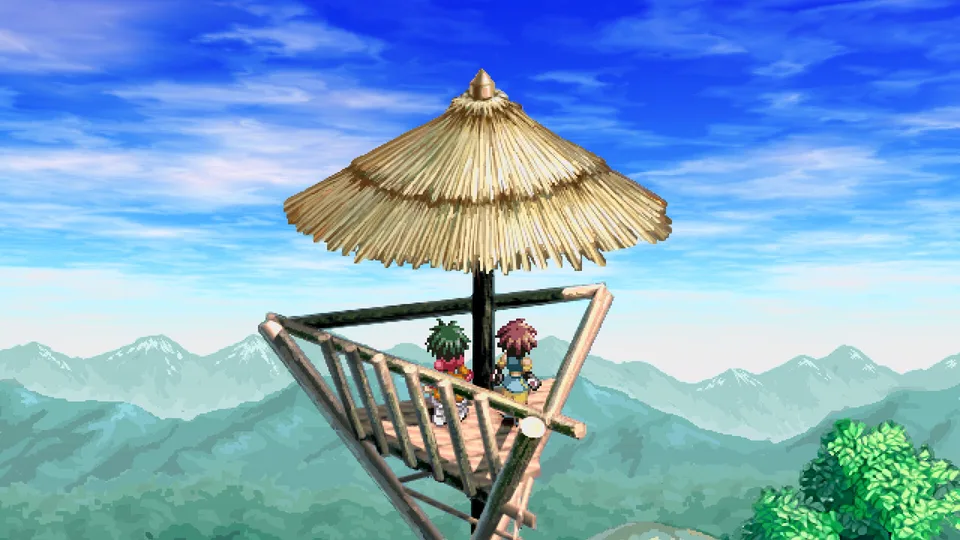
The graphical presentation offers a mix of crisp updates and distinct stylistic choices. Character sprites have been significantly cleaned up, retaining sharp, crisp pixel quality regardless of camera zoom levels. This solves the blurring issues present in older handheld iterations.
However, the environmental textures and background assets present a more nuanced picture. Players can freely toggle between the remastered graphics and the original style. While the remastered textures provide a smoother look, certain foliage clusters, background blends, and high-density pixel art areas can occasionally appear smushed together or washed out. Purists who prefer the natural look of the original pixel art can switch back instantly, making the option a welcome inclusion for players sensitive to asset touch-ups.
Audio, Interface, and Localization
The audio department benefits from a newly recorded English re-dubbing that breathes fresh life into the character interactions. Skits—a staple of the series—can now be accessed and viewed by camping on the world map. Since the game does not prompt you when a skit is available, players must camp frequently to ensure they do not miss any characterization moments, particularly since many skits from this era were originally omitted outside of Japan.
The user interface retains a clean, legible design, though some players note a slight mobile-game-port aesthetic in its font styling. Full audio and subtitle support is available across multiple languages, including English, Japanese, French, German, Italian, Spanish, and Chinese, ensuring broad accessibility worldwide.
Warning
Camping restores party HP and allows skits to play, but it does not restore TP or revive fallen party members. Always stock up on life bottles and recovery items before resting.
System Requirements and Steam Deck Compatibility
Running Tales of Eternia Remastered on PC requires modest hardware specifications, making it highly accessible across modern setups and portable gaming rigs.
Furthermore, the game holds a Verified rating for Steam Deck compatibility, meaning it runs smoothly out of the box with full controller mapping and optimized performance for handheld play.
Conclusion: Final Verdict
Tales of Eternia Remastered earns a solid 8 out of 10 rating. It succeeds in honoring its 26-year-old roots while providing enough flexibility, quality-of-life adjustments, and sprite refinements to satisfy both nostalgic veterans and modern JRPG fans. While certain archaic movement quirks and background texture blends remain, the inclusion of graphic toggles, customizable boost functions, and regional accessibility makes this definitive release a must-play entry on Steam.
Is local co-op multiplayer included in Tales of Eternia Remastered?
No. Unlike the original PlayStation 1 release, this version follows the PSP port structure and is strictly a single-player experience without local multiplayer support.
Can I switch back to the original graphics if I don't like the remastered textures?
Yes. Players can freely toggle between the remastered visual style and the original art style at any time through the game settings.
Does the game require an internet connection to play on Steam?
Once downloaded and installed, the game supports offline play, though an internet connection is required for initial activation, updates, and cloud sync features.